2012-02-29

Girls gone duplicate

Item: Girl's reversible frock
Yarn: Baby merino from Gjestal in a painted pink&red&peach, and Kitten Mohair from Gjestal in hot pink
Grams: 123 g


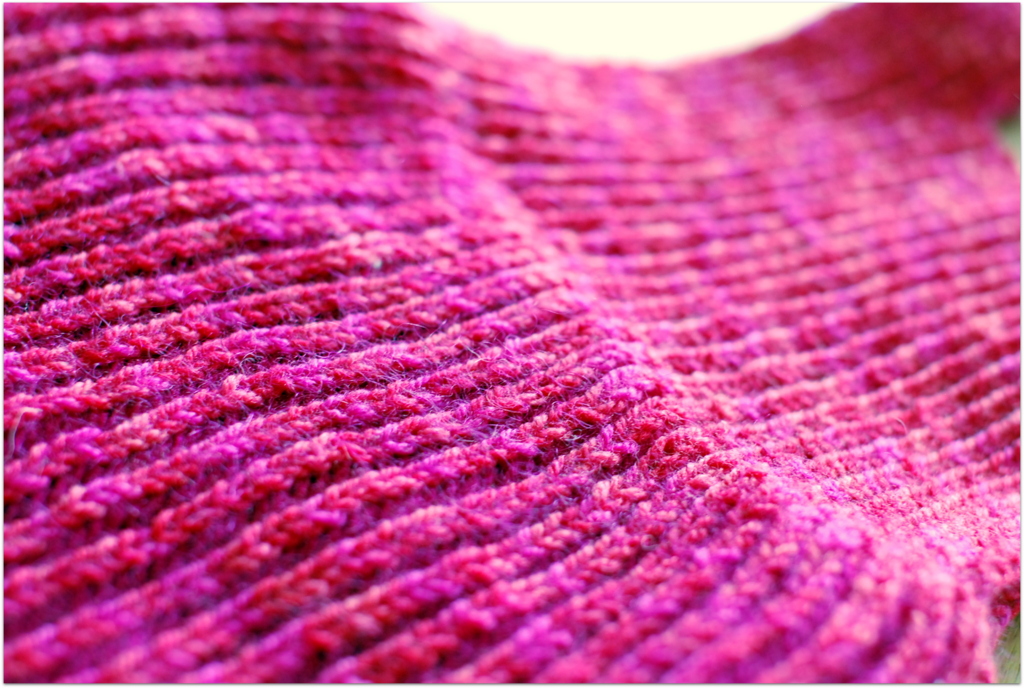
This is Pickles' reversible frock. A while back, they hosted an creativity contest with this pattern, and I eagerly cast on this frock with a combination of mohair and baby merino. The pattern creates a reversible frock, which allows the wearer to choose to show off the fancy mohair version or the ever-changing painted version. 


However, I never got to participate in the contest, as I didn't finish on time. This mummy business sure takes a lot of time ;) 

I did the yoke in simple ribbing with a reversed purl, which I always find creates a nice twisted finish. The hot pink mohair makes a nice touch to the inside (or outside) of the reversible dress. I love Pickles' idea of patent knitting with two different colours!

2011-12-14

Mobile baby, Mobile

Item: Baby mobile
Yarn: Drops Safran, various colours
Grams: 50 g Yellow, 60 g other colours, 110 g in total


We're expecting our first baby, a little baby boy will join us in January. For his nursery, I have made this delicious mobile, using the frame of an old lampshade to suspend it from. The placeholder for the lightbulb now holds a cute little yellow sun, shining down upon the clouds, birds, trees and my little baby boy. 


I've crocheted the various elements, and the yellow trees are inspired from this Ferm Living bedding. They have tiny bells inside them, so that they make a tingling noise when disturbed.  A little birdie is perched on top of the lampshade, looking down on the (hopefully) sleeping baby. 


2011-11-16

We all live in a Yellow Cushmarine


Item: Yellow crocheted cushion
Yarn: Heilo from Dale
Grams: 70 g


A cushion for the nursery, as yellow as can be. Is it a New York taxi? Or is it a submarine? Or perhaps a solar explosion? 


Crocheted on a needle size 4 mm, it is made entirely out of single crochets, starting with simple chain stitches, as many as you need to cover one length of the cushion (not the circumference, just one length). Then you start with the single crochet stitches, one stitch in each chain stitch. When you reach the end of the chain stitches, you continue stitching a single crochet in each chain stitch from the other side, adding some extra stitches in each of the two corners. Doing this means you can crochet round and round rather than back and forth, and still not have to sew together the bottom of the cushion, only the top. You'll actually make something that looks a bit like a bag, which you'll sew together at the top. 


The nice thing about crocheting cushions is that you don't have to fasten any loose threads, I simply just tie a knot when joining two threads, hiding the knot on what will be the inside of the cushion. It will never show! So I only have to fasten the final thread used to sew together the opening on the top of the cushion :)

2011-08-04

Pram goes retro

Item: Pram afghan
Yarn: Loads of different ones, all from the 70s, corduroy backing

When I was a baby, my mother made this small afghan for me, intended as a cover for my pram, on top of the baby duvet. Isn't it gorgeous? Truly inspired, I think. It is primarily knitted, from loads of different yarns, some of them coloured with plant dyes by my mother herself. And the colours just pop, mostly reds and browns and oranges. And the backing is a brick red corduroy, matching perfectly! 


And now it is passed on to my baby boy, when he decides to join us in January some time. His pram will be the hottest pram in town! 


2010-09-14

Stars in mummy's eyes

Item: Baby jacket with accessories
Yarn: Baby merino from DROPS in buttery yellow and creamy white
Grams: 87 g

 A new baby means a new mum, and new mum usually has stars in her eyes whenever she is gazing at her new offspring.


This baby jacket will make sure that those stars are always there, using daisy stitches to create lovely borders for the bottom of the jacket, the sleeves and the hat.

The creamy white and the buttery yellow is a perfect gender-neutral combination, and the yellow buttons match the yellow yarn perfectly, as though they were made for each other (lucky purchase, as I did not have a yarn sample with me to the button store).

The pattern is from Pickles, the Lazy Daisy baby jacket, with a few minor alterations to the amount of daisy stitches. I made the border at the bottom of the jacket thinner, and added borders at the bottom of the sleeves. The jacket, hat and booties are all knitted with circular needles (40cm), size 4.5 mm.

The hat was made without a pattern, just casting on a suitable amount of stitches. With daisy stitches, it is important that the amount of stitches can be divided by 3 + 2. For instance, you can cast on 77 stitches = (3 * 25) + 2.

Knit in the round until you have a suitable amount of rounds, enough to cover the baby's head from the baby's forehead to where flat top of the head starts. Then you are ready to start decreasing. For a baby's hat, I decrease quite rapidly compared to an adult's hat.


Now, yet another baby is soon ready to put stars in the new mother's eyes!

2010-08-30

Warm-a-wrist

Item: Hand wrist warmers with alternative ribbing
Yarn: Extra fine merino wool in "Mørk reinlav" from Pickles
Grams: 40 g

 Working with computers a lot can be quite hard on the hands. Particularly in the winter time, when the office gets chilly, a pair of hand wrist warmers is a treat, making it easy to use the keyboard and the mouse even though it's below freezing outside the window.

These hand warmers are made from non-scratchy merino wool, and are knitted in an alternative ribbing pattern, inspired by the Women's Hand Wrist Warmers pattern. Using a yarn that doesn't scratch too much is essential when making hand wrist warmers, as the wrists itch easily.


1 skein of Pickles extra fine merino was required to make the pair of hand wrist warmers, leaving a little. Each piece covers the hand from the knuckles some length passed the wrist, approximately 20 cm long in total.

2010-08-10

Superfit baby hat

Item: Classic baby hat with a superb fit
Yarn: Silk Wool from Nøstebarn
Grams: 12 g

This is my favourite style of baby hat, I've knitted a dozen of them. They are fun to knit, and fits a baby's head perfectly.

I've come across several different patterns, some are knitted in the round, harder to knit perhaps, but they require a minimum of sewing afterwards. Others are knitted back and forth, easier to knit, but requiring more sewing in the end.

This pattern is from Garnstudio, but knitted in a thinner yarn than the pattern says, shrinking the size down one or two sizes. This particular hat is for a newborn, and I always prefer knitting newborn clothing in the softest and most natural yarns, not imposing anything unnatural onto the precious little one.

A heart to give away

Item: Winged Heart Tattoo
Yarn: Pure new wool (Vestlandsgarn from Gjestal)
Grams: 30 g + stuffing

Lots of my girlfriends are currently expecting babies, it's a regular baby boom out there. I always take care to make something special for the baby, something handmade that (hopefully :S) will be treasured.

It is not only the baby that is new to the world, the parenting role is also new to many of my friends. So why not welcome the new parents as well as the new baby?

So I've knitted this lovely heart, based on the Winged Heart Tattoo pattern by Jujube & Lolo. It reminds me a lot of the embroidery patterns in the fabulous embroidery books by Jenny Hart, Embroidered Effects and Sublime Stitching. Check out her cool website as well, Sublime Stitching.

I've altered the word in the tattoo, of course it has to be Norwegian, not English. Mamma! I stitched the letters after assembling the heart and the banner, even though the pattern says you should attach the banner first and embroider the letters, and then sew together the heart. I found it easier to attach the banner after the heart was stuffed, as it was easier to position the banner then. The pattern calls for felted wings, but I've skipped those in this case.

The heart is stuffed with regular stuffing, but if I'd had any left, I would have added some dried lavender as well, which would add a lovely scent. 

And to top it all of, a teddy, of course!

2010-06-08

Heather relish

Item: Heather Tribute Socks
Yarn: Lamb wool from Nøstebarn in colour 32 Lyng (Heather)
Grams: 37 g

When I spotted the Tribute Socks at Knitty, I immediately knew that I wanted to have a go at knitting them. I even tagged it as a future yarn consumption here at the wild-grown yarn stash. The pattern requires a delicate yarn, and the lamb wool from Nøstebarn is just that, paired with double-pointed needles size 2mm.

2mm knitting needles are so delicate and thin that they easily bend. This time, I used the Symfonie Wood double-pointed knitting needles, they did bend a little, but not as much as the other brands I've tried at this size. I prefer wooden knitting needles, as they don't make as much noise when knitting. If anyone know of and can recommend some really wonderful knitting needles, especially in the smaller sizes, please post!

The socks begin with a picot edging. The pattern instructs you to leave the edging "open", that is, to sew it together afterwards, when the sock is finished. However, I prefer to fasten the edging as I go along, saving me the job of sewing it together later. This is accomplished by folding the picot edging over,  knitting each stitch together with a stitch picked up from the first row.

The pattern did have a bit of a ruining effect on the picot edging, as it made the edging a bit loop-sided. As you can see in the picture to the right, the front of the picot edging is higher than the side of the picot edging. Luckily, a proper blocking of the knitting will remove the loop-sidedness to some extent.

What I really did like about this pattern, beside the lovely and intricate instep pattern, was the three stitches on each side of the heel flap that was knitted in garter stitch. It's not a big thing, but I've never done it before. Usually I just slip the first stitch of each round of the heel flap, creating big loops that is used later to easily pick up stitches when starting on the instep later on. However, this usually leaves me with noticeable gaps, because the loops are so big. But this method, knitting the first three and the last three stitches in garter stitch, leaves no noticeable gaps. However, it is somewhat trickier to pick up the stitches for the instep but still doable!

And the intricate pattern: it is simple lovely!

2010-05-30

Cherry baby

Item: Cherry pink baby jacket and baby hat for infant
Yarn: Baby Merino from Gjestal Spinneri, superwash
Grams: 64 g (jacket) + 18 g (hat) = 82 g

A childhood friend of mine is soon having her first child, and it is announced to be a baby girl!

Picking colours for knitting projects for a baby girl often means choosing pastel pink and lilacs, understandable, as they are very delicate and yummy colours, I think. But in this case, the mother of the baby girl is not particularly keen on pink! In fact, she can't stand it!

But as the brave (and very possibly foolishly so) knitter I am, I'm still venturing for a pink project. For once, I can be quite sure that the end result will look nothing like the rest of the baby girl's wardrobe, as pink probably will be shunned. But how on earth am I to lure this jacket and hat past the keeper of the wardrobe, i.e. the mother?

By using a vibrant mix of cherry, fuchsia, and coral, mixed together in a single lovely yarn! No baby pastels here, no pale pink and no luscious lilac!

The project consists of a jacket and a matching hat. The pattern for the jacket is a very simple raglan sweater, knitted from the bottom up. The end result is a size 0 to 3 months, but probably only for the smaller range of babies. Raglans can be knitted both bottom-up and top-down. The top-down method is perhaps a little bit easier to use when knitting without a pattern, as you start with a suitable neck size, and continue increasing with the raglan technique, until the shoulder width suits its intended wearer. However, this particular jacket is knitted bottom-up.

All the edgings of the jacket have a simple garter stitch edging, to match the hat. Two tiny buttons are sewn on, as a simple fastening, leaving most of the jacket open at the front.

The neck of the jacket is knitted in a different direction than the rest of the jacket. When finished with the required amount of decreases, I've continued the garter stitch edging from the front opening of the jacket up and around the neckline. In some patterns, similar edging is knitted separately and sewn on afterwards. I usually prefer to avoid as much sewing as possible, so I've fastened the edging by knitting one mask of the edging together with one mask of the neckline, one at the time, until the edging has worked its way all around the neckline, from one side of the front opening to the other, "eating up" every single mask of the neckline on its way.

The hat is knitted in the well-fitting and I guess quite well-known "devil hat" design. When I say well-fitting, I mean two things: (1) The design creates an easily recognisable dip down to cover the baby's forehead, making it look a little bit as a the baby has horns (but only in a funny way, not a creepy way!). (2) The design fits the baby's head wonderfully, sticking on no matter what, and keeping every important part warm, both the head, the ears and the forehead.


So now you are very welcome to the world, baby girl!